Articles in this Volume

Research Article Open Access
Skill mismatch and career aspirations of humanities students in vocational schools: a Jiangxi case study
China has built the world's largest vocational education system, yet concerns remain about whether vocational graduates are able to realise their career goals. This study focuses on humanities and liberal arts students in Chinese vocational colleges, examining how they experience skill mismatch and how this shapes their career aspirations. Drawing on a qualitative case study at a vocational college in Jiangxi Province, the research uses semi-structured interviews, supported by questionnaire data, to explore students' perceptions of curriculum relevance, internship experiences, and career guidance. The findings show that skill mismatch among humanities students is not simply an individual problem, but is structurally embedded within China's vocational education system. Two mechanisms are particularly salient: curriculum lag, shaped by institutional and resource constraints, and career guidance that students perceive as weak and lacking practical relevance. Together, these dynamics contribute to uncertainty about employment prospects, lowered expectations, and increasingly constrained career aspirations. By foregrounding students' lived experiences, this study contributes to the literature on skill mismatch in vocational education by highlighting how career aspirations are formed through everyday encounters with institutional structures, curricular arrangements, and credential hierarchies.
Show more
Read Article PDF
Cite
Research Article Open Access
Policy implementation for the recruitment of high-level talent in local Sino-foreign cooperative universities: what is done, why it is done, and what can be done
Article thumbnail
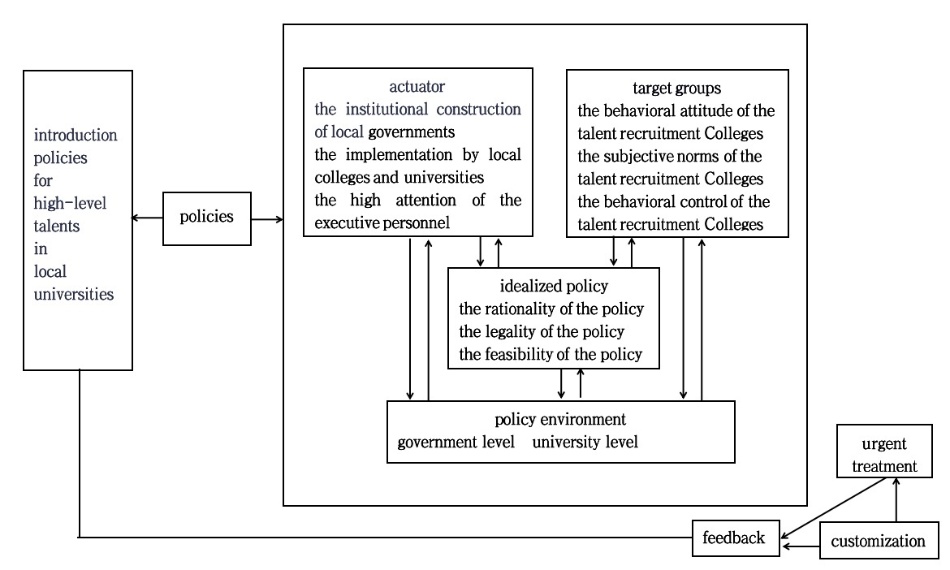
High-level talent, as a critical strategic resource, plays a pivotal role in enabling local Sino-foreign cooperative universities to pursue upward development and achieve the goal of institutional upgrading. Smith's policy implementation process model indicates that an idealized talent recruitment policy, a supportive internal and external recruitment environment, coordinated mechanisms among implementing agencies, and the strong willingness of target groups together constitute a robust driving mechanism for attracting high-level talent to such institutions. In practice, however, local Sino-foreign cooperative universities tend to encounter a range of unintended negative effects in the process of recruiting high-level talent, including mismatches between recruited personnel and key disciplinary priorities, increased systemic risks, intensified conflicts within high-level talent groups, and difficulties in effectively utilizing performance evaluation outcomes. To promote the healthy and orderly development of high-level talent teams, these universities should refine disciplinary orientations to enhance person–position fit, conduct thorough cost–benefit analyses to mitigate human capital investment risks, resolve interest conflicts arising from talent aggregation to avoid diseconomies, and focus on appointment-based systems to establish a sound evaluation mechanism for high-level talent.
Show more
Read Article PDF
Cite